
How to Buy a Suit in 2026: Fit, Fabric, and Price — A Complete Guide from Hollywood Suits
Quick answer: To buy a suit that fits, match your jacket size to your chest measurement (chest in inches minus ~7 for athletic builds gives your trouser waist, the standard "drop 6/7"), choose fabric by use — pure wool for year-round business wear, TR (poly-viscose) blends for budget and durability, linen for summer — and expect to pay $200–$400 for a quality TR suit or $400–$800 for wool in 2026. Shoulder fit is the one thing a tailor can't fix, so get that right first.
At Hollywood Suits, we don't just review suits — we cut, size, and sell them. Our team builds sizing scales and production runs for thousands of suits a year across modern, slim, and Big & Tall fits. This guide covers what we'd tell a friend before he spends a dollar.

How should a suit fit?

Five checkpoints, in priority order:
- Shoulders: The seam ends exactly where your shoulder bone ends. No divots, no overhang. This is set during manufacturing and cannot be economically altered — if the shoulder is wrong, put the suit back.
- Chest: You should be able to slide a flat hand between the buttoned jacket and your chest. An "X" pulling at the button means it's too tight.
- Jacket length: The hem should roughly cover your seat; with arms relaxed, your knuckles land near the hem.
- Sleeves: End at the wrist bone, showing ¼–½ inch of shirt cuff.
- Trousers: Waist sits comfortably without a belt cinching folds of fabric; a slight break (or none) at the shoe is current.
What do suit sizes like 40R actually mean?

The number is your chest measurement in inches; the letter is your height range. S (Short) roughly 5'4"–5'7", R (Regular) 5'8"–5'11", L (Long) 6'0"–6'3". Most suits are sold "nested" with a standard drop: a 40R jacket comes with 34" trousers (drop 6) or 33" (drop 7, slimmer cuts). If your build doesn't match the drop — bigger seat, athletic thighs, fuller midsection — look for separates or a Big & Tall program cut on its own block rather than sized up from a regular pattern. A true Big & Tall suit is re-proportioned through the shoulders, chest, and rise; a "scaled-up" regular suit is not.
Wool vs. TR vs. linen: which suit fabric should you choose?

| Fabric | Best for | Pros | Cons | Typical 2026 price |
|---|---|---|---|---|
| 100% wool | Year-round business, weddings | Breathes, drapes well, recovers from wrinkles overnight | Costs more; needs dry cleaning | $400–$800 |
| TR blend (poly-viscose) | First suit, travel, frequent wear | Durable, wrinkle-resistant, holds color, best value | Breathes less than wool | $200–$400 |
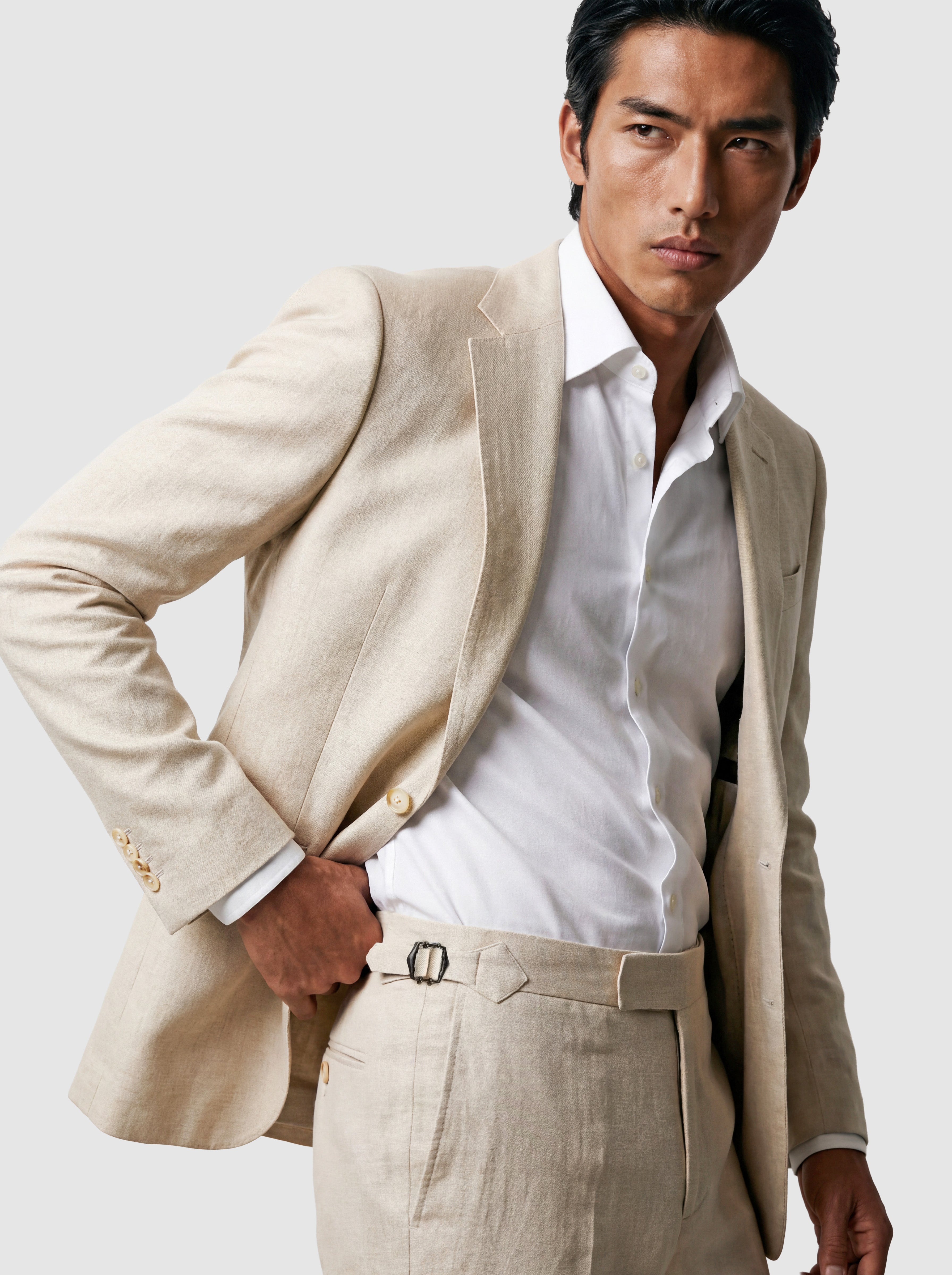
| Wool-linen / linen | Summer, outdoor weddings | Coolest option, distinctive texture | Wrinkles by design; seasonal | $250–$500 |
A common misconception: "polyester blend" doesn't mean cheap construction. A well-cut TR suit from a good factory will outlast a poorly made wool suit. What matters more than fiber content is the cut block, the canvas/fusing quality, and pattern consistency between sizes — things you can judge by how consistently a brand's 40R fits versus its 44R.
How much should you spend on a suit in 2026?
- Under $200: Possible, but check shoulder construction and lining quality closely.
- $200–$400: The value sweet spot — quality TR suits and entry wool blends live here.
- $400–$800: Quality 100% wool, better canvassing, more fit options.
- $800+: Finer wools (Super 120s+), half/full canvas, diminishing returns for most buyers.
Budget $20–$60 for alterations (sleeves, trouser hem, waist) — a $250 suit tailored to you beats an $800 suit off the rack.
How is a $99 suit possible?
Because at Hollywood Suits we did what the industry calls impossible: we manufacture our own suits. No importer, no wholesaler, no licensing markup between the factory and your closet — which is how we sell TR suits at $99 and $133 without cutting corners on construction.
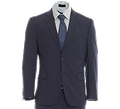
Our best seller is the $133 Joe Vince modern fit suit: a TR fabric blended with wool, which gives it the drape, recovery, and hand of a far more expensive suit — superior fabric quality and fit at a very affordable price.

Shop the Joe Vince Suit — $133
What is a half-canvas suit, and is it worth it?
Inside every suit jacket there is either a sewn-in canvas (horsehair and wool interlining) or a glued fusible. A half-canvas suit has real canvas through the chest and lapel: the jacket drapes naturally, molds to your body over time, and the lapel rolls instead of lying flat and stiff. It is the single biggest construction upgrade you can buy, and it normally lives on suits at $800 and up.
Here is where manufacturing our own suits pays off again: our Camiloni wool-cashmere line is half-canvas construction at $499 — roughly half the price a comparable half-canvas suit sells for elsewhere. Same chest piece, same lapel roll, no markup chain.

Shop the Camiloni Collection — $499
What color should your first suit be?
Navy first, charcoal second, mid-grey third. All three work for interviews, weddings, and funerals. Black reads formal/evening; patterns (pinstripe, windowpane) come after the solids are covered. For weddings in 2026, lighter blues, sage, and tan continue to trend for daytime events; navy and charcoal remain the safe standard for guests.
Frequently asked questions
Can a tailor make any suit fit?
No. Sleeves, hems, and waists are easy; taking in a chest is moderate; shoulders and rise are effectively no-go. Buy for the shoulders, tailor the rest.
Should I buy a two-piece or three-piece suit?

Two-piece for most uses. Add a vest for weddings or if you remove your jacket often — it keeps you "dressed" without it.
How many suits do I need?
One good navy suit covers 90% of events. A working professional rotation is three: navy, charcoal, and one seasonal or patterned option.
What’s the difference between slim, tailored, modern, and classic fit?
It’s the cut block, not your size — your chest measurement stays the same across all four. Slim fit is the trimmest: higher armhole, narrow chest and leg, usually drop 7. Tailored fit keeps that sharp, close silhouette but adds room through the chest and thigh — the choice if slim pulls at the button but you still want a modern line. Modern fit sits in the middle and flatters the widest range of builds. Classic fit gives the fullest chest, seat, and leg, typically drop 6.
How do I know if a suit is well made?
Check pattern matching at the seams, even stitching in the lining, a collar that hugs your shirt without gapping, and sleeve buttons that aren't glued. Press the chest between your fingers — a slight float (canvas) beats a stiff board (heavy fusing).